What is a crypto payment gateway? How it works
What happens between a customer’s wallet and your balance: the locked price, the address, confirmations and screening. And what to check before you choose one.
Dit artikel is alleen in het Engels beschikbaar.
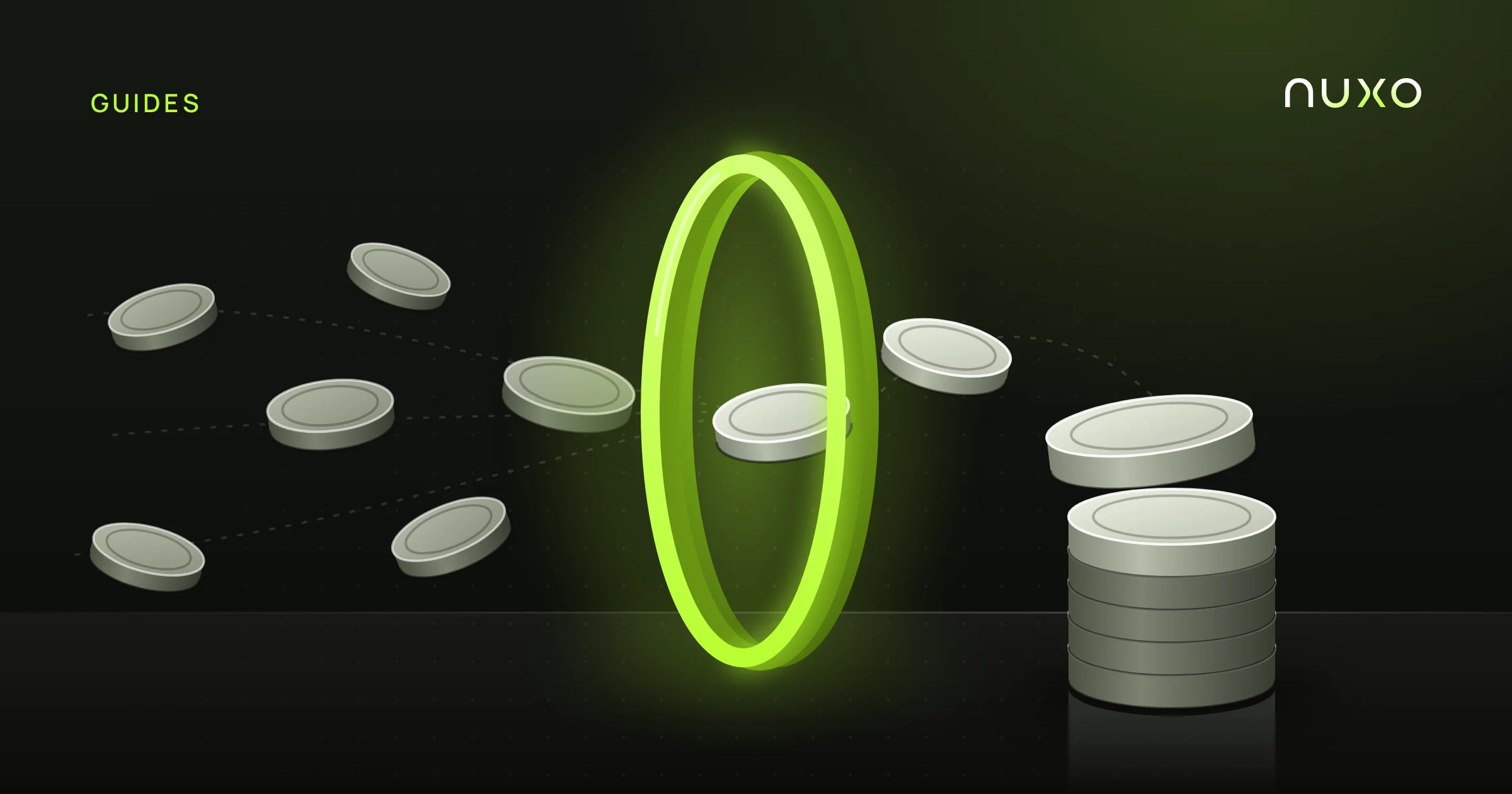
A crypto payment gateway is a service that takes cryptocurrency payments for a business. You may also see it called a cryptocurrency payment gateway or a crypto payment processor. It tells the customer what to pay and where, watches the blockchain until the payment is final, and credits the business, so the business never runs blockchain software or keeps private keys. It does for crypto what a card processor does for cards.
What a gateway does, step by step
- You set a price in your own currency, on a checkout, an invoice or a payment link.
- The gateway quotes it in the coin your customer picks and locks the rate for a set time, 15 minutes at Nuxo, so the amount does not move while they pay.
- It gives an address and an exact amount, with a QR code their wallet can read.
- Your customer pays from their wallet or an exchange account.
- The gateway watches the network and counts the confirmations each network needs before a payment is final.
- It credits your balance, less its fee, and tells your system with a webhook.
- You keep the coins, convert them or send them out, when you choose.
The wait in step 5 depends on the network. Among those Nuxo takes, Lightning settles at once, Solana confirms in 1 second and Bitcoin Cash takes about 60 minutes. How long a crypto payment takes has the figures, network by network.
Gateway, wallet or exchange
All three handle crypto, but only one is built to take a payment for an order.
| Wallet | Exchange | Payment gateway | |
|---|---|---|---|
| Built for | Holding and sending your own coins | Buying, selling and trading | Taking payments from customers |
| Prices an order in your currency | No | No | Yes |
| Tells you which order was paid | No | No | Yes, by webhook |
| Handles a wrong amount or a refund | By hand | No | Yes |
| Checks who sent the money | No | For its own customers | Yes, before crediting |
Custodial or self-hosted
A custodial gateway holds your balance until you send it, the way a card processor holds a payout. You sign in, see your money and send it out; the keys and the nodes are the gateway’s job. Nuxo is custodial.
Uit het Helpcentrum
Waar staat mijn saldo?
In wallets die Nuxo beheert, tot je het verstuurt. Elke beweging is een regel in je grootboek, dat je kunt exporteren wanneer je wilt. Onze risico-informatie legt uit wat het betekent om een saldo in munten aan te houden.
Het antwoord lezenA self-hosted gateway is software you run yourself. Payments go straight to wallets you control and nobody holds them for you, but you run the server and the nodes, keep it updated, and handle every refund, wrong amount and network by hand. It suits a business with an engineer to spare and a few coins to take.
What your customer sees
On a hosted checkout your customer sees the amount in your currency and in their coin, the address and a QR code, and the time left to pay. They scan with their wallet or copy the address and the exact amount, then watch each confirmation come in, and the page takes them back to your site once it is paid. Sending too little or too much is handled on the page. See the payment page
What to check before you choose one
- The coins and networks your customers hold. Stablecoins like USDT and USDC travel on many networks; a gateway that takes only one of them turns customers away.
- The whole cost. The rate, any fixed fee per payment, who pays the network fee to receive, and what converting and paying out cost. The published fees, compared
- How fast you are credited, network by network.
- What happens when a payment goes wrong: too little, too much, too late, or on the wrong network.
- Ways in without code, links and invoices, and an API with webhooks and a test mode for when you build.
- Screening and verification: whether incoming payments are checked, and what you must provide and when.
- Where your balance is held, and what you can export for your accountant.
How Nuxo does it
Nuxo is a custodial crypto payment gateway: 76 assets on 43 networks from one integration, a flat 1% on what you receive, and the network fee to bring each payment into your balance is ours. Payments are screened before they are credited, and every change to your balance is a line in your ledger. How to accept crypto payments walks through the ways to start.
Uit het Helpcentrum
Wie betaalt de netwerkkosten?
Bij inkomend geld doen wij dat: de betaling van een klant naar je saldo brengen kost op de meeste blockchains netwerkkosten, en die zijn voor onze rekening. Uitgaand geld verstuur je zelf, dus die kosten zijn voor jou: bij een uitbetaling gaan ze van je saldo af en zie je ze voordat je verstuurt, bij een terugbetaling gaan ze af van het bedrag dat wordt teruggestuurd, en bij een salaris komen ze erbovenop, zodat de medewerker het volledige bedrag krijgt.
Het antwoord lezenVragen
Is a crypto payment gateway the same as a crypto exchange?
No. An exchange is where people buy, sell and trade coins. A gateway takes payments for a business: it prices the order, gives the customer an address, confirms the payment and credits the business. Some gateways convert what you receive through an exchange, but that is one step of many.
Can my customers pay from any wallet?
From any wallet that can send the coin on the network they picked, and from an exchange account that can withdraw to an address. The checkout shows which network the address is on, so they send it on the right one.
 X
 LinkedIn